From Co-Dependence to Co-Leadership: A New Model for Parents
We are managing everything together. But I don’t feel like we are leading together.
There was no major crisis in Nikhil and Kavya’s home.
No affair.
No screaming matches every night.
No dramatic collapse.
From the outside, they looked like what many people would call a “good family.”
They were responsible.
Their children were cared for.
Bills were paid.
School meetings were attended.
Festivals were celebrated.
Family photos looked warm.
And yet, something in the house felt tired.
Not broken.
Just burdened.
One evening, after a small argument about their daughter’s bedtime routine, Kavya sat on the edge of the bed and said quietly,
“We are managing everything together. But I don’t feel like we are leading together.”
Nikhil didn’t argue.
He didn’t defend himself.
Because somewhere inside, he knew she was right.
He was involved.
But she was carrying.
He was present in the house.
But she was present in the system.
That is the quiet truth in many modern families:
both parents may be participating, but only one is often carrying the emotional and mental architecture of the home.
And that is where co-dependence begins to wear the costume of teamwork.
The Family Pattern That Looks Functional But Feels Heavy
Co-dependence in parenting is rarely obvious.
It doesn’t always look like helplessness, addiction, or emotional chaos.
Sometimes it looks respectable. Organized. Even loving.
It looks like one parent always knowing what needs to happen next.
One parent remembering the birthdays, the school forms, the changing moods, the tension between siblings, the medicine refills, the emotional aftermath of a rough school day.
It looks like one parent carrying not only the work of the house, but the weather of the house.
And the other parent?
Not absent. Not careless. Often deeply loving.
But responsive rather than anticipatory. Helpful rather than fully owning. Present after being prompted rather than emotionally scanning the field.
So the family works.
But it does not breathe well.
One parent becomes the emotional engine.
The other becomes a secondary driver.
And over time, both suffer in different ways.
The over-functioning parent becomes tired, sharp, resentful, unseen.
The under-functioning parent becomes hesitant, defensive, uncertain, and quietly diminished in leadership.
The children then grow up inside a system where one adult carries pressure and the other carries reaction.
This is not co-leadership.
This is imbalance with good intentions.
Why This Pattern Is So Common in Indian Families
To understand this, we have to look deeper than individual behavior.
We have to look at culture.
In many Indian families, men and women were not raised to become co-leaders.
They were raised to become role-holders.
The father’s role was clear: provide, decide, protect, stay steady, don’t over-express.
The mother’s role was also clear: nurture, manage, adapt, absorb, smooth, remember, hold.
For generations, this model worked because life itself was structured around fixed roles.
Joint families shared load.
Communities were tighter.
Children had more adults around them.
Mothers had invisible support systems, even if imperfect.
Fathers were not expected to be emotionally expressive; they were expected to be dependable.
But the modern family has changed.
Today, many mothers are not only caregiving but also earning, organizing, emotionally regulating, and socially managing.
And many fathers are more involved than their fathers ever were—but not always retrained internally for the emotional and mental complexity of modern family life.
So we now have homes where men are more physically present, but not always mentally integrated into the invisible running of the family.
And women are more empowered, but also more overloaded.
This creates a hidden cultural fracture.
The old model is fading.
The new model has not yet been learned.
So families improvise.
And that improvisation often becomes tension.
Kavya’s Fatigue Was Not About Chores
Kavya was not angry because she had to do dishes or arrange school supplies.
She was tired because she had become the permanent holder of family awareness.
She noticed when their son had gone unusually quiet after school.
She noticed when Nikhil’s tone had become harsher over the week.
She noticed when the house felt emotionally cluttered.
She noticed when her own body was running on fumes.
But noticing, in many homes, becomes a trap.
Because the one who notices first is often the one who becomes responsible for responding first.
And when that keeps happening, the family begins to depend on one person’s vigilance.
That dependence may look like competence.
But inside, it feels lonely.
What hurt Kavya most was not that Nikhil didn’t love the family.
It was that he often arrived late to realities she had already been carrying for days.
By the time he saw the problem, she was already exhausted from holding it.
That is the emotional burden of co-dependence:
one person becomes the family’s emotional early-warning system, and the other becomes the backup.
Even when both are good people, the arrangement quietly erodes respect.
Because love without shared leadership starts to feel like unpaid management.
Nikhil’s Side of the Story Matters Too
Nikhil was not lazy.
He was not unwilling.
He was not irresponsible.
He was, in many ways, a decent man trying to be a better father than the one he had known.
But he had inherited a different emotional training.
He had grown up in a home where his father rarely explained feelings.
Leadership meant stability.
Stability meant not overreacting.
And not overreacting often got confused with not engaging deeply unless necessary.
So Nikhil learned to step in when something was visible.
He did not learn to sense what was building before it became visible.
When Kavya said, “You only act after I’ve already carried it,” he felt hurt.
Because in his mind, he was helping. He was trying. He was showing up.
And this is where many men get trapped.
They interpret their willingness to help as equal partnership.
But willingness is not the same as leadership.
To help is to join after direction.
To lead is to notice, initiate, and own.
That difference can feel harsh when first named.
But it is also liberating.
Because once a father sees it, he can grow into a different role—not as a guilty husband, but as an integrated partner.
The Generational Psychology Beneath It
Children do not just grow up watching what chores get done.
They grow up absorbing how emotional and practical responsibility is distributed.
If they repeatedly see mother as the one who tracks, remembers, anticipates, and absorbs, they internalize that family stability depends on one exhausted hero.
If they see father as good-hearted but late to emotional realities, they learn that men participate after prompting, not from embodied awareness.
This is how roles get passed down.
Daughters may grow up over-functioning in relationships because that is what love looked like.
Sons may grow up assuming love means showing up when asked, not learning how to read the field for themselves.
And then everyone wonders why adulthood feels heavy.
The truth is, many adults are not just living their own lives.
They are reenacting family systems.
That is why changing parenting is never just about tasks.
It is about inheritance.
When two parents move from co-dependence to co-leadership, they are not just improving teamwork.
They are interrupting generational conditioning.
What Co-Leadership Actually Looks Like
Co-leadership is not a corporate term forced into family life.
It is something much more human.
It means both adults begin to see themselves as stewards of the home’s emotional and practical culture.
Not equal in every task.
Not identical in personality.
Not always balanced day to day.
But united in ownership.
In a co-led home:
one parent is not the permanent emotional janitor
one parent is not the default memory bank
one parent is not always translating everyone’s needs
one parent is not constantly shrinking so the system can run
Instead, both adults learn to ask:
What is building here?
What is needed before this becomes a problem?
What is my part to carry fully?
How do we reset together before resentment becomes the language of the house?
This is a profound shift.
Because families do not become peaceful when conflict disappears.
They become peaceful when responsibility becomes shared.
The Conversation That Changed Their Home
Nikhil and Kavya didn’t transform everything with one breakthrough weekend.
It began more simply.
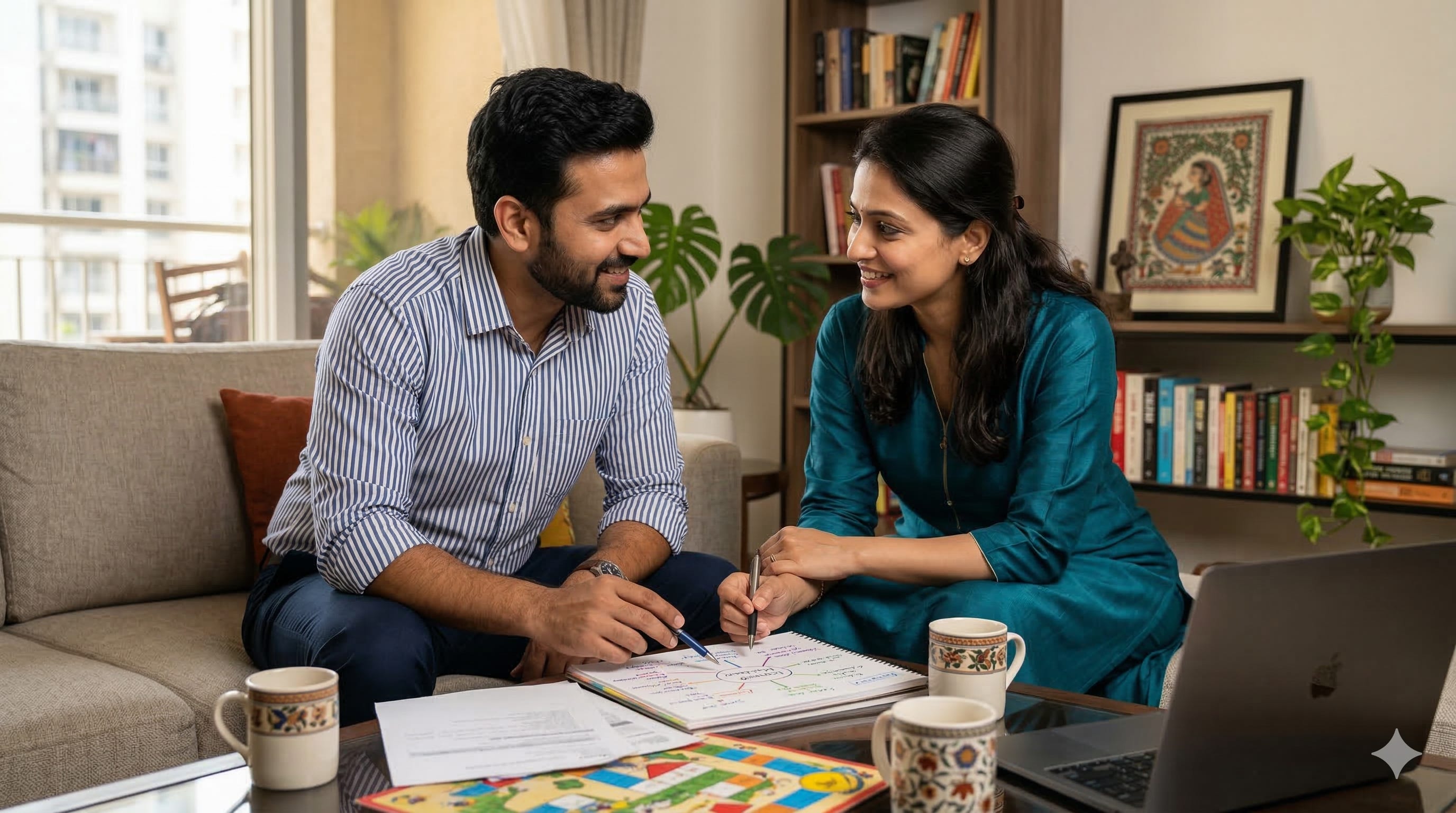
One Sunday evening, after the children slept, they sat down with tea and named the invisible work.
Not chores.
Invisible work.
Who tracks the emotional state of the children?
Who remembers school deadlines?
Who initiates difficult conversations?
Who repairs after tension?
Who notices when one child is being left out?
Who carries mental lists no one sees?
The answers were uneven.
Not because Nikhil didn’t care.
Because care had not yet become conscious ownership.
That night, instead of saying, “Tell me how to help,” he asked a better question:
“What can I take full leadership of—without needing reminders?”
That question changed the emotional structure of the marriage.
Because help still keeps one person as manager.
Ownership creates dignity on both sides.
He took over school communication completely.
He began a weekly check-in with their son.
He became the one to initiate bedtime rhythm and post-conflict repair with the children when needed.
Not perfectly.
But consistently.
And slowly, Kavya’s nervous system began to soften.
Not because life became easy.
But because she was no longer alone inside the system.
The Emotional Result Was Bigger Than the Practical Result
The most powerful change was not that tasks were redistributed.
It was that the emotional atmosphere of the house changed.
Kavya became less sharp.
Nikhil became less defensive.
Their children became less chaotic in the evenings.
Why?
Because children often react not only to what parents say, but to what parents carry.
When one parent is overburdened, children feel it.
When both parents are grounded, children settle more easily into trust.
This is what many families miss.
Co-leadership is not just fair.
It is regulating.
It stabilizes the entire family system.
Two grounded parents create a different emotional field than one overloaded parent and one reactive parent.
And that field becomes the child’s definition of partnership, responsibility, and love.
A New Model for Modern Parents
The future of healthy parenting will not be built on one strong mother and one supportive father.
It will not be built on martyrdom dressed as devotion.
It will not be built on one parent carrying the invisible and the other carrying the visible.
It will be built on emotional adulthood.
On fathers who understand that love must mature into ownership.
On mothers who are no longer expected to carry everything just because they can sense everything.
On couples who stop measuring who is more tired and start designing how they will lead together.
This does not remove difficulty.
But it removes unnecessary loneliness.
And that alone changes the soul of a home.
The Takeaway
Many families are not suffering from lack of love.
They are suffering from outdated role patterns that look normal but quietly drain everyone inside them.
Co-dependence keeps a family moving.
Co-leadership helps a family mature.
One produces function.
The other produces trust.
One creates hidden resentment.
The other creates shared strength.
Children do not need one tired hero holding the whole house together.
They need two adults growing in awareness, ownership, and repair.
That is the family model worth building now.
Not perfect equality.
Not performance.
Not polished parenting.
But two people willing to become emotionally and practically trustworthy together.
Quotable Close
“Co-dependence keeps a family functioning. Co-leadership teaches a family how to flourish.”
CTA – Begin Here
If this stirred something in you, start here:
🌿 Why Loving Parents Still FAIL at Home
A simple guide to help you see the emotional patterns quietly shaping your family.


