The Nicest Person in the House is Often the Most Tired
If I stop… everything will fall apart
Rohit didn’t collapse in the office.
He collapsed on a Sunday afternoon - in his own bedroom - while his son banged the door like a tiny drummer on a mission.
“Papa! Come! Come na!”
Rohit wanted to answer.
His body didn’t.
Not dramatically. Not like a movie.
Just a strange heaviness in the chest - like someone placed a sandbag on his ribs.
He sat on the edge of the bed, leaned forward, elbows on knees, and did that thing men do when they don’t want anyone to notice they’re not okay.
He stared at the floor.
The fan kept spinning. The world kept functioning.
And inside him, a quiet thought rose like a confession:
If I stop… everything will fall apart.
In the living room his wife, Aarti, was saying the same sentence she has said a thousand times, in a thousand different tones.
“Are you coming or not?”
And Rohit, without looking at her, replied with the sentence that ends intimacy in many homes:
“I’m tired, yaar.”
But what he meant was not “I’m tired.”
What he meant was:
I don’t know how to be a person anymore. I only know how to be useful.
This is not a story about bad husbands or dramatic wives.
This is a story about good people.
The kind your family praises.
And the kind who silently burn out, get sick, grow numb, or explode - because nobody taught them one skill:
How to listen to their own needs without guilt.
Dr. Gabor Maté tells a brutal truth from years of working with terminally ill patients:
Many people who get sick are not unlucky.
They are trained.
Trained to be dutiful. Responsible. Nice. Helpful.
Trained to swallow anger, ignore exhaustion, and keep showing up.
And when they can’t say no… their body eventually says it for them.
Scene 1: The “Good Husband” Who Becomes a Ghost
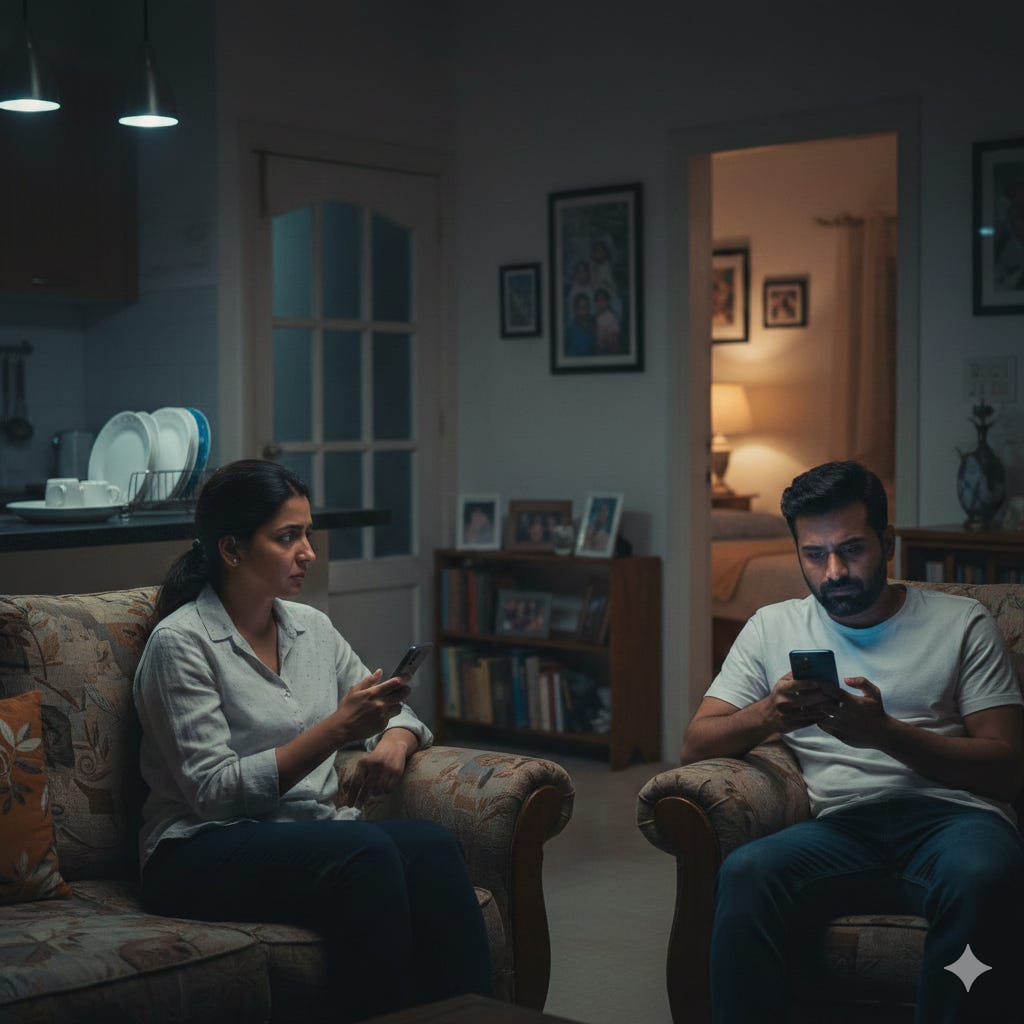
It’s 9:47 PM.
The house is quiet in that post-dinner way - plates washed, lights dim, the smell of soap still on the steel sink.
Aarti sits on the sofa, pretending to scroll, but her thumb isn’t really moving.
She’s waiting.
Rohit walks in from the bedroom with his phone in hand like it’s an oxygen mask.
He doesn’t even sit fully. Half-sits. Half-falls.
Aarti tries to keep it soft.
“Can we talk for 10 minutes?”
Rohit hears: more work.
His mind immediately does the math of survival:
If we talk, it will become an argument. If it becomes an argument, I’ll fail. If I fail, I’ll be the villain. I don’t have energy to be the villain.
So he gives her the common dialogue.
“Not now. I had a long day.”
Aarti’s stomach tightens. The familiar heat rises behind her eyes.
Her mind says:
He chooses everything over me. Office gets his best. I get leftovers.
Her mouth says:
“Rohit… you’re always tired.”
Rohit’s mind fires back:
Do you think I’m doing all this for myself? I’m carrying the family.
His mouth says:
“You don’t understand the pressure.”
Now watch the tragedy.
Both are telling the truth.
But neither is telling the deeper truth.
Because the deeper truth requires vulnerability.
And in many homes, vulnerability feels unsafe.
Rohit isn’t only tired from work.
He’s tired from being a role.
The Provider. The Responsible One. The Stable One.
He has trained himself to be useful, not honest.
So his feelings don’t come out as feelings.
They come out as irritation.
Or silence.
Or scrolling.
Or a sudden shout at the child because the child spilled water and the sound of that spill felt like an attack on his nervous system.
Rohit is not losing his temper.
He is losing his capacity.
Scene 2: The “Good Wife” Who Disappears While Smiling
Aarti is praised.
If you ask relatives, they’ll say:
“She handles everything. Such a mature woman.”
She wakes early, packs tiffins, remembers homework, answers school WhatsApp groups, calls the electrician, pays the milk bill, cooks, cleans, coordinates birthdays, checks her mother-in-law’s medicines, and still looks presentable when guests arrive.
And if someone asks how she’s doing, she answers with the standard Indian survival sentence:
“Bas… chal raha hai.”
But at night, when she finally lies down, the silence becomes loud.
Her body aches in places she can’t explain.
She stares at the ceiling and her mind whispers:
When did my life become only responsibilities?
And then, because she is a “good person,” another thought quickly scolds her:
Don’t be ungrateful. Look at what you have. Other women have it worse.
This is how many people stay trapped.
They don’t need a jailer.
They have an inner voice that calls self-care “selfishness.”
So Aarti keeps going.
Even when she’s hurt.
Even when she feels unseen.
Even when she’s angry.
Especially when she’s angry.
Because she learned something early:
Anger makes you unsafe. Anger makes you unlovable. Anger makes you a problem.
So she swallows anger.
She becomes polite resentment.
She becomes functional loneliness.
And the body keeps the score.
Maybe it starts small:
headaches
hormonal imbalance
breathlessness
sudden tears in the kitchen
irritation that surprises even her
Then one day something happens.
A health report. A panic attack. A breakdown that looks “out of nowhere” to everyone else.
But it wasn’t out of nowhere.
It was out of years.
This is what Maté saw repeatedly in palliative care: people who were celebrated for how much they carried - and then destroyed by the same pattern.
The obituaries praise the multitasker.
But nobody writes:
“She never rested.”
“She never said no.”
“She never expressed her hurt.”
“She lived like her needs didn’t matter.”
Scene 3: The Child Who Learns Love = Self-Abandonment
Your child is watching both of you.
Not in a dramatic way.
In the quiet way children watch.
Your son watches Rohit come home and withdraw into the phone.
He doesn’t have the language for it, but he feels it.
He learns:
Papa is here, but not here.
Your daughter watches Aarti constantly adjusting.
She sees her mother smile while swallowing pain.
She learns:
Love means tolerating.
Then something else happens.
Because children are emotional sponges with no filter.
They start adapting to the emotional environment.
If parents fight, one child becomes the peacemaker.
If mother looks overwhelmed, the child becomes “low maintenance.”
If father gets angry, the child becomes silent.
And everyone praises the child:
“Such a good boy.”
“Such a mature girl.”
But what they’re really seeing is a child who has learned:
My feelings are inconvenient.
Later, that child grows into an adult who:
can’t say no
feels guilty resting
overworks
avoids conflict
chooses emotionally unavailable partners
smiles while breaking
And society will praise them too.
We praise self-abandonment when it’s wrapped in responsibility.
The Hidden Question Most People Never Ask
Maté says doctors will treat your inflammation, rash, asthma, arthritis, stress symptoms.
But nobody asks the real question.
So you must.
What is my body trying to say NO to… that I keep saying YES to?
A job that eats your nervous system?
A marriage pattern where you stay silent to keep peace?
A family expectation that drains you?
A life where you don’t rest unless you’re sick?
A role you’re terrified to drop because you don’t know who you are without it?
This question is not philosophical.
It is practical.
Because illness is often the body’s boundary when your mouth doesn’t have one.
“If you don’t know how to say no,” Maté says, “your body will say it for you.”
In coughs.
In migraines.
In IBS.
In insomnia.
In rage.
In numbness.
In the sudden moment you realize you can’t feel joy even when everything looks “fine.”
What Self-Prioritizing Actually Looks Like in Marriage
Self-prioritizing is not:
becoming selfish
ignoring your partner
acting like your family doesn’t matter
Self-prioritizing is emotional leadership.
It’s you refusing to abandon yourself - so you don’t abandon them in other ways.
Because when you abandon yourself, one of these happens:
You become resentful.
You become numb.
You become explosive.
You become absent.
You become sick.
Emotional leadership means you catch it earlier.
When it’s still a small signal.
Before it becomes a big consequence.
A tiny practice that changes the emotional climate of the home
Try this for 7 days.
1) One honest sentence per day
Not a lecture. Not a fight.
One sentence that is true.
“I’m overwhelmed and I need 20 minutes.”
“I felt hurt when that happened.”
“I’m anxious and I need reassurance.”
“I don’t want to commit to that right now.”
“I need help with this.”
Notice how your nervous system reacts when you say it.
That’s your conditioning being challenged.
2) One boundary per week
A boundary is clarity, not control.
“No work calls after 8 PM.”
“Sundays are rest days.”
“We don’t shout in this house.”
“I need 30 minutes to decompress when I come home.”
“I can’t host guests this month.”
Boundaries protect love.
They don’t reduce it.
The real ending of Rohit and Aarti’s story
Rohit didn’t become a better husband by learning more communication techniques.
He became a better husband when he learned to listen to his own body early.
He noticed the tight jaw.
The shallow breath.
The urge to scroll.
The impatience with his child.
The heaviness in the chest.
And instead of pushing through, he said one new sentence:
“I’m not okay. I need support.”
That sentence didn’t make him weak.
It made him available.
Aarti didn’t become a better wife by trying harder.
She became a better wife when she stopped disappearing.
When she stopped calling her needs “drama.”
When she allowed disappointment - so she could finally have boundaries.
And here’s the part most people miss:
Their children changed too.
Because kids don’t need perfect parents.
They need regulated parents.
When the emotional climate becomes safer, children stop adapting through fear.
They start expressing.
They start relaxing.
They start feeling.
That is generational change.
Not through advice.
Through nervous system leadership.
Closing: Why Emotional Leadership helps - and how
Being an emotional leader doesn’t mean you control everyone’s emotions.
It means you stop sacrificing yourself to keep the peace.
You notice your signals early.
You express instead of suppress.
You set boundaries before resentment.
You ask for support before collapse.
And the result is real:
fewer fights that spiral
faster repair after conflict
more respect in daily conversations
calmer kids because the emotional air at home is cleaner
a body that doesn’t need to scream to be heard
If you’re reading this and thinking, “This is me,” don’t judge yourself.
This pattern was built in childhood.
But it can be rewired in adulthood.
Want to know what pattern you’re running?
I built a short assessment that helps you identify your emotional leadership style - what you do under stress, what you avoid, and what your family experiences when you’re overwhelmed.
Take the Emotional Leadership Quiz here:
https://learn.superdadsalliance.com/web/checkout/68fa94350db23a411e291ba8
And if you want daily reminders and tools to practice emotional leadership in real life (not theory), join my WhatsApp broadcast:
https://whatsapp.com/channel/0029VaBAwO2CcW4i08KovR0a
Because the goal is simple:
Don’t wait for your body to force a boundary.
Lead your emotions early - so your love has somewhere safe to live.


